A polished listing is no longer enough to stand out. The real estate content trends shaping 2026 are changing how agents attract buyers, win listings, and market properties across social media, property portals, email campaigns, and websites.
The biggest shift is not just about creating more content. It is about creating content faster, distributing it across multiple channels, and maintaining consistent quality at scale.
Buyers consume property content differently than they did just a few years ago. Sellers expect agents to provide modern marketing. Meanwhile, agents and brokerages need efficient systems that allow them to promote every listing without dramatically increasing costs or workload.
The professionals who adapt to these changes will be better positioned to win listings, generate leads, and grow their businesses.
Real estate content trends are becoming more video-first and AI-powered
For years, real estate marketing focused on a handful of premium assets: professional photography, brochures, and occasional video tours.
Today, a single listing often requires:
Short-form videos for social media
Vertical clips for Instagram Reels, TikTok-style feeds, and YouTube Shorts that capture attention quickly.
Property walkthrough videos
Room-by-room videos that help buyers understand layout, flow, and key selling points.
Listing descriptions
Compelling copy for MLS, portals, email campaigns, and seller presentation materials.
Email marketing content
Concise messaging that reintroduces listings to your database when status or price changes.
Social media captions
Platform-specific copy that pairs with video and photo assets across every channel.
Paid advertising creatives
Formatted assets for Facebook, Instagram, and other paid channels that drive inquiries.
Producing all of this manually can quickly become expensive and time-consuming.
That is why one of the most important real estate content trends is the adoption of scalable content production systems. Modern agents are increasingly using AI-powered tools to transform existing listing assets into multiple marketing formats in minutes rather than days.
Speed and scale are the new content advantage
1. Short-form video is now essential
Short-form video continues to dominate attention across social media platforms.
Whether buyers are browsing Instagram Reels, Facebook, YouTube Shorts, or TikTok-style feeds, video consistently generates higher engagement than static content.
The good news is that agents no longer need expensive production teams for every property. Many successful listings are now promoted through professional slideshow-style videos built from existing property photos.
For example, instead of manually editing every video, agents can use solutions such as real estate video marketing ideas to quickly create engaging property videos that showcase key selling points while maintaining a professional brand image.
The competitive advantage is often speed. Publishing a strong video today usually performs better than publishing a perfect video next week.
2. Property photos are being repurposed into multiple marketing assets
Most listings already have high-quality photography.
The challenge is turning those photos into enough content to maximize visibility.
One of the strongest real estate content trends is content repurposing. Instead of using photos only for property portals, agents are transforming them into:
- Property videos
- Social media reels
- Listing teasers
- Advertising creatives
- Seller presentation examples
This allows one photo shoot to support multiple marketing channels.
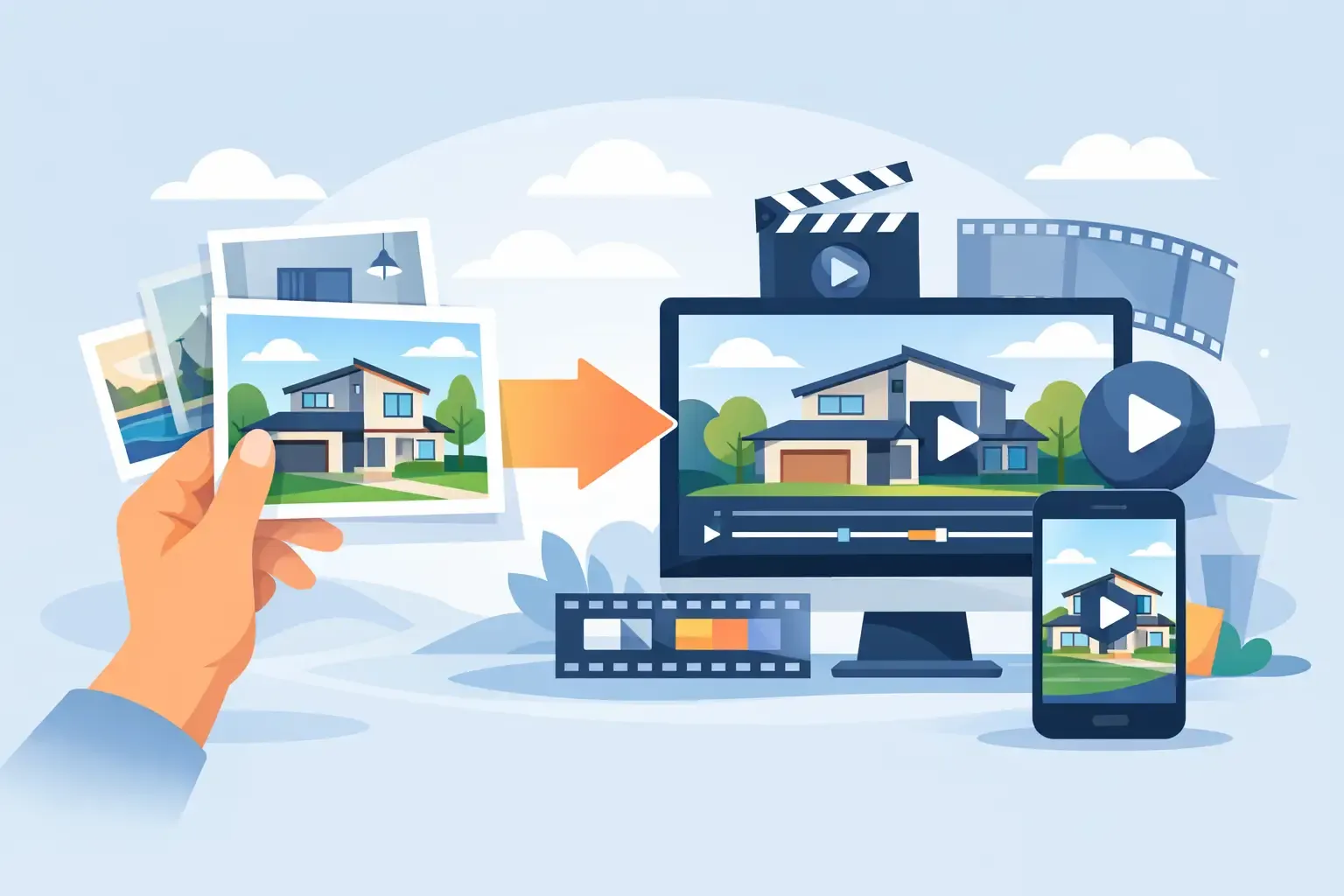
Many agents now use automated workflows to turn property photos into video fast because it dramatically reduces production time while increasing content output.
The result is better listing exposure without additional photography costs.
3. Multi-channel content creation is becoming standard
The days of creating one marketing asset and posting it everywhere are over.
Every channel has different requirements:
Instagram
Prefers vertical formats, fast pacing, and captions that work without sound.
YouTube
Favors longer viewing sessions and content that holds attention past the first few seconds.
Facebook
Rewards shareable content that sparks comments and forwards within local networks.
Property portals
Focus on clear information, strong imagery, and descriptions that support search visibility.
Email campaigns
Require concise messaging, a clear call to action, and assets sized for inbox previews.
Successful real estate marketers plan content distribution before production begins.
This trend is driving demand for flexible content systems that can generate multiple versions of the same property marketing asset without requiring additional editing work.
4. AI is becoming core marketing infrastructure
Artificial intelligence is no longer viewed as an experiment.
Instead, it is becoming a core component of real estate marketing operations.
AI is increasingly used for:
Property video creation
Transform listing photos into branded walkthrough videos in minutes instead of days.
Listing descriptions
Generate consistent, professional copy from property details without starting from scratch.
Image enhancement
Improve brightness, remove distractions, and optimize photos before they go live.
Virtual staging
Help buyers visualize empty or dated spaces without physical staging costs.
Content generation
Produce captions, ad copy, and presentation materials from the same listing data.
Marketing automation
Publish updates across channels faster when price, status, or open house details change.
For example, many agents now use AI-powered tools to automatically generate property descriptions from listing information instead of writing each one manually.
Solutions like the listing description generator help agents create consistent, professional descriptions while saving valuable time.
The goal is not replacing creativity. The goal is removing repetitive work so agents can focus on selling properties and building client relationships.
5. Marketing is becoming a listing presentation advantage
Real estate content no longer serves only buyers.
It also helps agents win more listings.
When sellers compare agents, one of the first questions they ask is:
“How will you market my property?”
Agents who can demonstrate a clear marketing process—including video creation, social promotion, and AI-enhanced content production—often have a significant advantage during listing presentations.
Showing examples of past marketing campaigns, property videos, and automated content workflows helps sellers visualize how their property will be promoted.
This trend is making marketing capabilities a key differentiator in competitive markets.
6. Authentic content is outperforming overproduced content
Luxury properties may still benefit from cinematic productions, but for most listings, authenticity and speed are becoming more valuable than excessive production quality.
Buyers primarily want to understand:
- Layout
- Room flow
- Natural light
- Features
- Property condition
Simple, professional, and informative content often outperforms highly produced videos that take weeks to create.
The most effective property videos usually include:
Strong opening visuals
Lead with the property's best room or exterior to stop the scroll in the first second.
Logical room progression
Guide viewers through the home in an order that mirrors a real walkthrough.
Clear text overlays
Highlight address, key features, and pricing without covering important visuals.
Consistent branding
Use the same fonts, colors, logos, and music style across every listing video.
Strong call to action
Tell viewers exactly what to do next — inquire, book a showing, or visit the listing page.
The emphasis is increasingly on clarity rather than complexity.
7. Efficiency is becoming the most important content metric
Views, likes, and engagement still matter.
However, many brokerages are now evaluating content performance through a broader business lens.
Production speed
How quickly can content be published after listing photos arrive?
Teams that launch video the same day often capture early buyer attention before competitors catch up.
Listing coverage
How many listings can be supported without adding headcount or outsourcing every property?
Scalable workflows let high-volume teams maintain video marketing across their entire portfolio.
Cost per listing
How much production cost can be reduced while maintaining professional quality?
Photo-to-video workflows often deliver strong ROI compared to custom videography on every property.
Business impact
Can content help win more seller appointments and improve listing conversion?
Marketing proof during listing presentations increasingly influences which agent sellers choose.
This represents one of the most important real estate content trends for 2026.
The most successful teams are not simply creating content. They are building efficient systems that allow them to create more content with fewer resources.
How VideoEstate.ai supports these real estate content trends
Many of the trends discussed above share a common challenge: producing high-quality content quickly.
VideoEstate.ai helps agents, brokerages, photographers, and marketing teams transform listing photos into professional property videos in minutes.
Instead of relying on complex editing software or expensive video production workflows, users can create scalable marketing assets that support social media, listing promotion, seller presentations, and advertising campaigns.
Browse real estate video examples to see what publish-ready output looks like, or explore AI video creation tools for real estate to build a repeatable workflow for your team.
As the industry moves toward faster, AI-powered marketing, having a repeatable content creation system becomes a competitive advantage.
The future of real estate content marketing
The direction of real estate marketing is clear.
Content is becoming:
- More video-focused
- More AI-assisted
- More scalable
- More multi-channel
- More performance-driven
Buyers expect richer visual experiences. Sellers expect stronger marketing strategies. Agents need efficient workflows that allow them to meet both expectations.
The professionals who build scalable content systems today will be better prepared to attract attention, win listings, and grow their businesses tomorrow.
Rather than chasing every new platform or marketing trend, focus on creating a repeatable content engine that helps every listing reach the market faster and more effectively.
Review real estate video pricing plans or solutions for real estate agency marketing when you are ready to scale that engine across your team.
Frequently asked questions
What are the biggest real estate content trends in 2026?
The biggest trends include short-form video, AI-generated marketing content, content repurposing, multi-channel distribution, and automated property marketing workflows that help agents create more content in less time.
Why is video important for real estate marketing?
Video helps buyers visualize a property more effectively than static photos alone. It also generates higher engagement on social media platforms and can improve seller confidence in an agent's marketing capabilities.
How can agents create more real estate content without hiring a marketing team?
Many agents use AI-powered platforms to automate content creation. These tools can generate videos, listing descriptions, social media content, and marketing assets from existing property photos and listing information.
How does AI help real estate marketing?
AI can assist with video creation, image enhancement, listing descriptions, virtual staging, and content generation. This reduces manual work and allows agents to market listings more efficiently.
What content should every real estate listing have?
At a minimum, every listing should include professional photography, a compelling listing description, short-form video content, social media promotion, and marketing materials that can be used during seller presentations.
Can property photos be turned into videos automatically?
Yes. Modern AI-powered tools can transform listing photos into professional property videos with transitions, branding, music, and text overlays, allowing agents to create marketing content quickly and at scale.