A listing goes live at 10 a.m. By noon, buyers have already scrolled past dozens of property photos across listing portals, social media feeds, and competitor websites. In today’s market, simply uploading images is no longer enough to stand out.
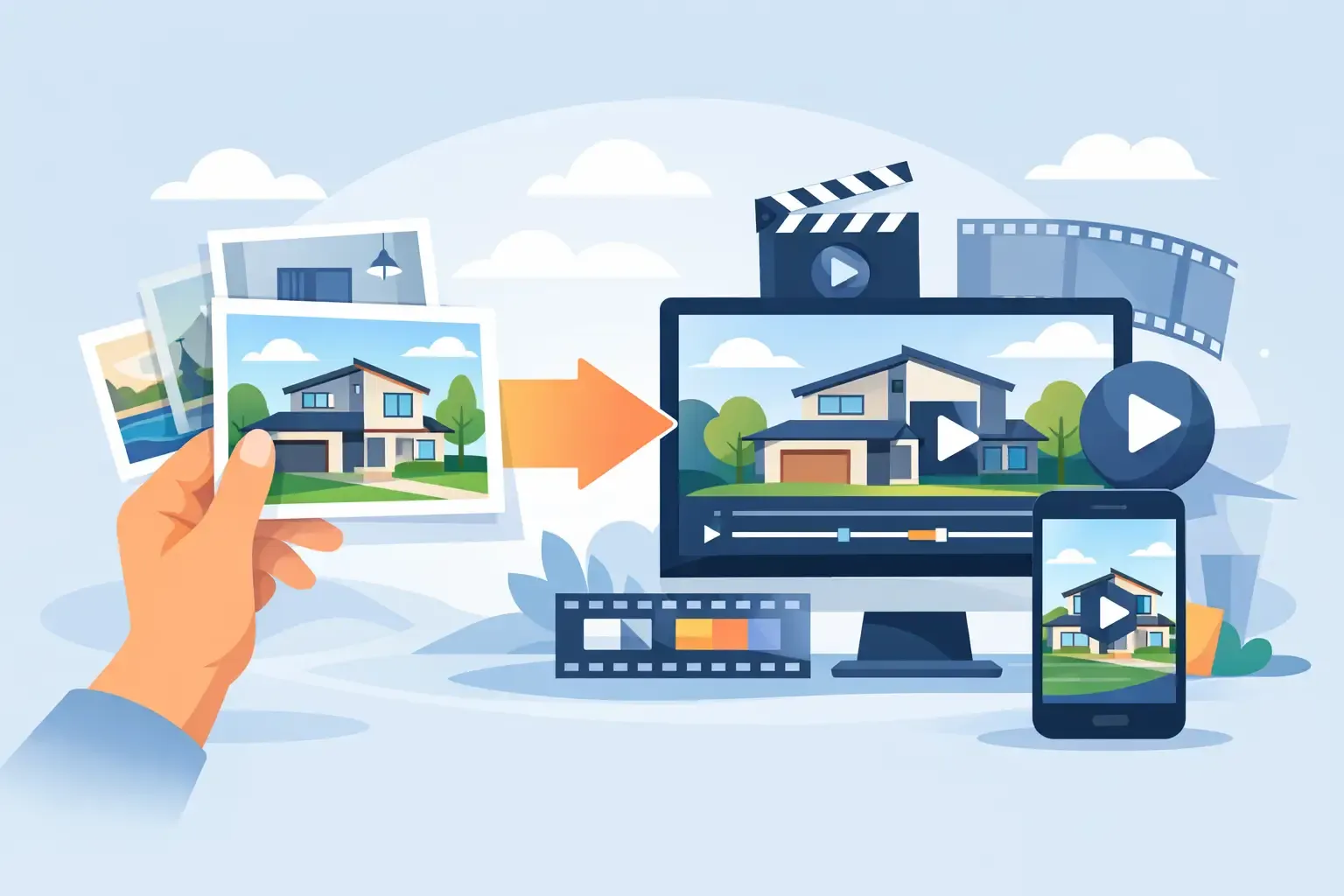
That is why more agents, brokers, marketers, and property developers are looking for ways to turn property photos into video quickly. A video creates movement, tells a story, and helps buyers engage with a property in a way that static galleries cannot.
The good news is that creating a professional real estate video from photos no longer requires a videographer, expensive editing software, or hours of manual work. With modern AI-powered tools like VideoEstate.ai, a folder of listing photos can become a polished property video in just a few minutes.
If you want to see what modern AI-generated real estate videos look like, browse these real estate video examples.
In this guide, you’ll learn how to turn property photos into video fast, why photo-to-video content works so well in real estate marketing, and how to create listing videos that help attract more buyers and win more sellers.
- Minutes
- From photos to published video
- Same day
- Launch when listing photos arrive
- Multi-format
- Vertical, square, and horizontal exports
Why real estate professionals turn property photos into video
Property photos and property videos serve different purposes.
Photos document. Video sells the experience.
This matters because modern real estate marketing happens across multiple channels:
- MLS listings
- Property websites
- Instagram Reels
- Facebook ads
- YouTube
- Email campaigns
- Listing presentations
- Developer marketing campaigns
A collection of photos works well on a listing page, but it becomes far more versatile when transformed into video. By turning property photos into video, agents can create content that works across every stage of the marketing funnel while maximizing the value of existing photography.
Benefits of turning property photos into video
The biggest advantage is speed.
Traditional real estate video production often requires scheduling a videographer, coordinating property access, capturing footage, editing, reviewing revisions, and exporting multiple formats. That process can take days or even weeks.
A photo-to-video workflow dramatically reduces production time while still delivering professional marketing assets.
Increased social media reach
Video consistently generates more engagement than static images on Instagram Reels, Facebook, TikTok, and YouTube Shorts.
Faster listing launches
Publish marketing content as soon as professional photos are available instead of waiting for a separate video shoot.
Lower marketing costs
Creating a real estate video from photos is often far more affordable than custom footage for every listing.
Better seller presentations
A professional video strategy demonstrates your marketing capabilities and strengthens listing presentations.
Consistent branding
Templates, intros, logos, and music help every property video maintain a polished, on-brand appearance.
Scalable output
Teams can repurpose the same photo set across websites, ads, email, and short-form social without reshooting.
When photo-to-video works best
Not every property requires a full cinematic production. Photo-to-video workflows work particularly well for residential listings, rentals, new developments, pre-construction projects, off-market properties, open house promotions, price reductions, brokerage campaigns, and investor portfolios.
If the property already has high-quality professional photography, there is often enough material to create a compelling video.
For luxury properties that rely heavily on lifestyle storytelling, drone footage, or neighborhood cinematography, traditional video may still add value. For most listings, turning property photos into video offers the best balance between speed, quality, and cost.
Property photo videos vs traditional real estate videos
| Traditional property video | Video from listing photos | |
|---|---|---|
| Strengths | Real camera movement, lifestyle and drone footage, neighborhood storytelling, premium presentation | Fast production, lower cost, scalable workflow, easy updates, immediate deployment |
| Trade-offs | Higher cost, longer timelines, more scheduling complexity, greater operational overhead | Less movement than filmed footage, less immersive storytelling, dependent on photo quality |
| Best for | Luxury lifestyle storytelling and premium cinematic marketing | High-volume teams that need professional video on every listing quickly |
For many real estate teams, the question is no longer which option is better. Instead, it is which option provides the best return for each listing.
How to turn property photos into video fast
The most effective workflow focuses on simplicity. The goal is not to spend hours editing. The goal is to create professional marketing content quickly and consistently.
1. Select photos that tell a story
Start by organizing images in a logical order. A strong sequence often looks like this:
- Exterior hero image
- Entryway
- Main living spaces
- Kitchen
- Dining areas
- Bedrooms
- Bathrooms
- Outdoor spaces
- Amenities
- Final hero shot
The best property videos guide viewers through the home rather than presenting random images.
2. Focus on pacing
Timing has a major impact on how buyers perceive a property. Fast pacing can feel energetic and social-media friendly. Slower pacing often feels more premium and luxurious.
A typical property video performs well when individual scenes remain visible long enough for viewers to absorb the details without feeling rushed.
3. Add motion effects carefully
Subtle movement can transform static images into engaging video content. Popular effects include slow zoom-ins, zoom-outs, pan effects, and gentle transitions.
The goal is to create visual interest while keeping attention focused on the property itself. Overusing effects can make a listing appear less professional.
4. Add relevant text
Text overlays should support the video, not dominate it. Useful additions include property address, location highlights, bedroom and bathroom counts, key selling points, and brokerage branding. Keep text concise and easy to scan.
5. Include music or voiceover
Music helps create emotion and improves the viewing experience. Voiceovers can be particularly useful for luxury properties, developer presentations, investor marketing, and remote buyer audiences.
With VideoEstate.ai, agents can add music and AI voiceovers directly within the same workflow instead of switching between multiple editing tools. Learn more about the platform’s AI music and voiceover features.
What makes a property video actually convert
A beautiful video is not automatically an effective marketing asset. The most successful real estate marketing videos share several characteristics.
High-quality source photos
Everything starts with photography. Strong lighting, clean composition, and consistent editing provide the foundation for an effective video.
Even the best AI tools cannot fully compensate for poor source images. However, AI-powered image editing can help improve brightness, remove distractions, enhance skies, declutter rooms, and optimize listing photos before they are turned into video. Learn more about AI image editing for real estate.
Consistent branding
Professional real estate teams maintain consistency across every listing: logo placement, fonts, colors, music style, intro sequences, and video length. Consistency builds trust and reinforces brand recognition.
Multi-platform formatting
Modern property marketing requires multiple formats. A video that works on YouTube may not perform well on Instagram Reels. The ability to quickly generate vertical, square, and horizontal videos is essential for maximizing distribution.
How AI helps turn property photos into video
AI has transformed how real estate content is produced. The value is not simply automation — it is speed and scalability.
Instead of manually editing every scene, AI-powered platforms can help agents and marketers:
- Generate property videos automatically
- Enhance listing photos
- Add motion effects
- Create voiceovers
- Apply branding
- Export multiple formats
This allows teams to publish more content without increasing headcount or outsourcing production.
For growing brokerages, developers, and real estate marketing teams, AI makes it possible to maintain consistent video output across dozens or even hundreds of listings.
VideoEstate.ai was built specifically for real estate professionals who need to create listing videos quickly without sacrificing quality. Unlike generic video editors, it focuses entirely on real estate marketing workflows. Learn more about the platform’s AI video creation tools for real estate.
Common mistakes that make property videos look cheap
Speed should never come at the expense of quality.
Overusing transitions
Fancy transitions rarely improve real estate videos. Simple, clean movement almost always looks more professional.
Using too much text
Buyers want to see the property. Large blocks of text often distract from important visual details.
Poor image ordering
A random collection of photos creates confusion. Always structure the video around how viewers naturally explore a home.
Inconsistent branding
Different fonts, logos, music styles, and editing approaches make a brokerage appear less professional.
Avoid one-size-fits-all styling
What to look for in a property photo-to-video tool
The best tools simplify production rather than adding complexity. Look for a platform that allows you to:
- Upload listing photos quickly
- Organize scenes easily
- Add automatic motion effects
- Include branding
- Add music and voiceovers
- Export multiple aspect ratios
- Make quick edits
- Generate videos in minutes
For real estate professionals, specialized tools often outperform generic video editors because they are designed specifically around listing marketing workflows.
If you manage multiple listings each month, it is worth exploring solutions designed specifically for real estate agency marketing.
Rather than forcing agents to learn complex editing software, these platforms focus on helping teams create professional property videos as efficiently as possible.
Why video matters more than ever in real estate marketing
Buyer expectations continue to rise. Sellers increasingly expect agents to provide video marketing. Social platforms prioritize video content. Competition for attention becomes more intense every year.
The teams that consistently publish high-quality video content gain a significant advantage.
Fortunately, creating video no longer requires expensive production workflows. By turning property photos into video, agents can create engaging marketing assets faster, reduce production costs, and increase the reach of every listing they represent.
The faster you can move from photos to published content, the faster your listings start generating attention. And in real estate marketing, attention is often the first step toward generating more inquiries, more viewings, and ultimately more transactions.
If you’re ready to create professional real estate videos from photos in minutes, explore VideoEstate.ai’s real estate video examples or review the available real estate video pricing plans.
Frequently asked questions
Can you turn property photos into a video?
Yes. Modern AI-powered real estate video tools can transform property photos into professional videos using motion effects, transitions, branding, music, and voiceovers.
What is the best way to create a real estate video from photos?
The fastest approach is to use a real estate-focused AI platform that automatically converts listing photos into a branded property video while minimizing manual editing.
How long should a property video be?
For social media, 30 to 60 seconds is often ideal. For property websites and listing presentations, videos between 60 and 120 seconds generally perform well.
Are AI-generated real estate videos effective?
Yes. AI-generated property videos help agents create content faster, maintain branding consistency, and publish marketing assets across multiple channels without traditional production costs.
Can I create vertical property videos for Instagram and TikTok?
Absolutely. Most modern property video platforms support vertical, square, and horizontal formats, allowing you to repurpose the same listing content across different platforms.