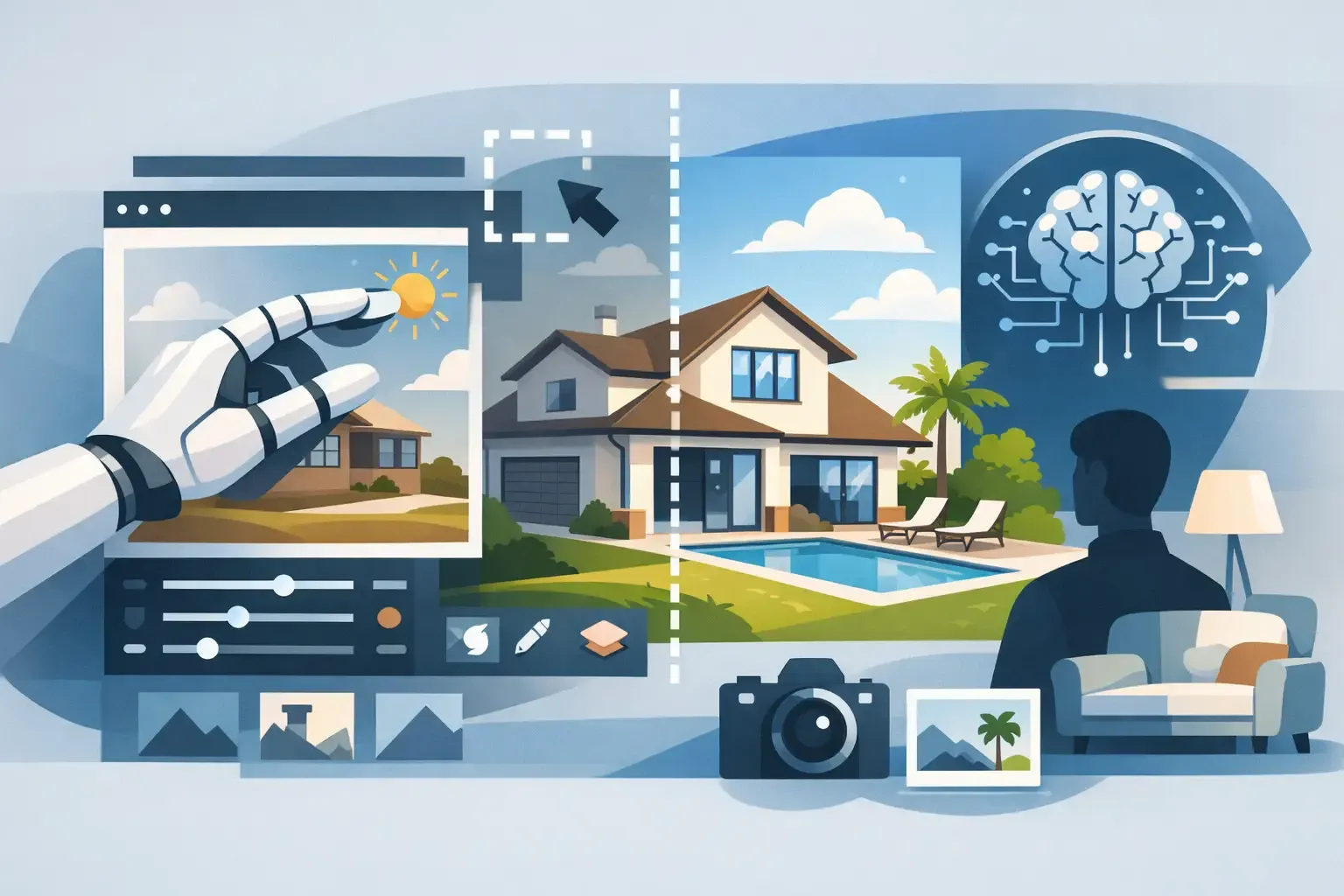
AI virtual staging is no longer just a way to furnish empty rooms digitally. It has become a core part of modern real estate marketing, helping agents, photographers, brokerages, and property marketers create listing-ready content faster than ever.
The latest AI virtual staging trends are reshaping how properties are presented online, how agents win listings, and how real estate teams produce content at scale. Instead of relying on slow, expensive staging workflows, professionals can now transform listing photos into polished marketing assets in minutes.
For real estate professionals, this shift matters because visual presentation impacts far more than listing views. It influences seller acquisition, social media engagement, advertising performance, and ultimately how quickly a property sells.
In this guide, we’ll explore the most important AI virtual staging trends shaping real estate marketing in 2026 and how agents can use them to create more effective listing campaigns.
Why AI virtual staging is becoming essential for real estate marketing
Traditional home staging remains effective, but it is expensive, time-consuming, and difficult to scale. Even manual virtual staging often involves multiple revisions, freelancers, and lengthy turnaround times.
AI changes that equation.
Modern real estate professionals need to:
Launch listings faster
Reduce delays between photo shoot and go-live across MLS, portals, and social channels.
Create more from existing photos
Turn one property shoot into staged images, videos, and advertising creatives.
Produce social media assets consistently
Maintain a steady flow of polished content without hiring for every listing.
Impress sellers during presentations
Show how quickly raw photos become professionally marketed listings.
Market across multiple channels
Distribute staged visuals on Instagram Reels, TikTok, Facebook, and listing portals simultaneously.
This is why AI virtual staging is increasingly becoming part of a complete real estate content workflow rather than a standalone service.
Today’s leading platforms combine virtual staging with image enhancement, video creation, slideshow generation, and social media content production—allowing agents to create an entire marketing campaign from a single property photo shoot.
1. Virtual staging is evolving into a complete content engine
One of the biggest AI virtual staging trends is that staged images are no longer the final deliverable.
A virtually staged photo can now be repurposed into:
Listing videos
Professional property videos built from staged room photos without reshooting.
Instagram Reels
Short-form vertical content that showcases staged spaces in scroll-stopping format.
TikTok property tours
Fast-paced room-by-room clips designed for discovery-driven social feeds.
Facebook advertising creatives
Polished visuals formatted for paid campaigns that drive listing inquiries.
Listing presentations
Seller-facing materials that demonstrate your marketing capabilities.
Property slideshows
Engaging visual sequences that highlight key rooms and selling points.
This dramatically increases the value of every property photo.
Instead of viewing virtual staging as a one-time enhancement, successful agents use it as the starting point for an entire marketing workflow.
For example, after staging a living room, the same image can be transformed into a professional property video using a dedicated listing video workflow, helping agents maximize the impact of every listing asset.
2. Realism is replacing generic design templates
Early virtual staging solutions often produced rooms that looked artificial or repetitive. Buyers could quickly recognize generic furniture sets applied to every property.
Today’s AI systems are significantly more sophisticated.
They can better understand:
Room dimensions
Furniture scale and placement that respects the actual proportions of the space.
Lighting conditions
Shadows, highlights, and color temperature that match the original photo.
Architectural style
Design choices aligned with the property's era, materials, and character.
Property positioning
Staging that reflects whether the home is urban, suburban, or luxury.
Market segment expectations
Furnishings and aesthetics suited to the likely buyer demographic.
A luxury penthouse should not be staged like a suburban family home, and buyers immediately notice when staging feels disconnected from the property’s identity.
As AI continues improving, realism is becoming the standard rather than the differentiator. The most effective virtual staging feels natural, believable, and aligned with the property’s target audience.
3. Speed is becoming a competitive advantage
While image quality remains important, speed often determines marketing success.
Properties that launch quickly generate momentum faster. Sellers increasingly expect agents to deliver polished marketing assets within hours rather than days.
AI virtual staging helps reduce:
- Editing delays
- Revision cycles
- Vendor coordination
- Marketing launch timelines
This creates a significant competitive advantage during listing presentations.
When agents can demonstrate how quickly they can transform raw property photos into professionally marketed listings, they position themselves as more modern and marketing-focused than competitors.
Combined with automated tools like AI-powered property video creation, fast staging workflows can dramatically shorten time-to-market for new listings.
4. Buyer-focused design is replacing one-style-fits-all staging
Another major trend is audience-specific staging.
Instead of applying the same contemporary furniture package to every listing, AI systems are becoming better at aligning designs with likely buyer preferences.
Examples include:
Minimalist designs for urban condos
Clean lines and compact layouts that appeal to city buyers and young professionals.
Family-friendly layouts for suburban homes
Comfortable, practical furniture arrangements that help families envision daily life.
Premium furnishings for luxury properties
High-end décor that matches the price point and architectural quality of the home.
Contemporary aesthetics for new developments
Modern styling that complements new construction and builder finishes.
This helps buyers emotionally connect with a space and imagine themselves living there.
The goal isn’t to create multiple versions of every room. It’s to create staging that reflects how the property is likely to be experienced by its target audience.
5. Virtual staging is merging with video creation
Perhaps the most important trend for real estate marketers is the convergence of staging and video production.
Photos alone are no longer enough.
Today’s buyers consume property content through:
- Instagram Reels
- TikTok videos
- YouTube Shorts
- Facebook videos
- Listing walkthroughs
As a result, staged photos increasingly serve as the foundation for video marketing.
Platforms such as VideoEstate.ai allow agents to move directly from enhanced or virtually staged images into professional property videos without rebuilding content from scratch.
This integrated approach helps agents create:
- Listing videos
- Social media videos
- Seller presentation content
- Property marketing campaigns
all from the same set of listing photos.
For teams managing multiple properties, this significantly improves marketing efficiency and scalability.
You can also combine staged photos with an AI-powered real estate slideshow maker to quickly create engaging visual presentations.
6. Compliance and transparency are becoming more important
As AI-generated visuals become more common, expectations around transparency are increasing.
Responsible virtual staging should help buyers visualize a property—not misrepresent it.
Stage responsibly, not deceptively
Best practices include:
- Staging empty rooms with furniture
- Enhancing lighting and presentation
- Removing temporary clutter when appropriate
- Preserving structural features accurately
Agents should avoid altering:
- Room dimensions
- Permanent fixtures
- Views from windows
- Lot characteristics
- Major architectural elements
Maintaining transparency protects both buyer trust and professional credibility.
As regulations around AI-generated content continue to evolve, ethical use of virtual staging will become increasingly important.
7. Marketing performance is finally being measured
Historically, staging decisions were often subjective.
Today, data-driven marketing is changing how real estate teams evaluate visual content.
Professionals increasingly measure:
Listing click-through rates
Whether staged images drive more portal views than unstaged alternatives.
Social media engagement
Likes, shares, saves, and comments on staged property content.
Advertising performance
Cost per lead and conversion rates on paid campaigns using staged visuals.
Time on listing pages
How long buyers spend exploring staged galleries before inquiring.
Lead generation metrics
Inquiries, showing requests, and contact form submissions tied to visual assets.
Content production efficiency
Time and cost to produce staged images and derivative marketing content.
The most valuable staged image is not necessarily the most beautiful one.
It’s the one that helps generate more engagement, improves marketing reach, and supports faster property sales.
This shift is encouraging brokerages and agents to evaluate virtual staging tools based on measurable business outcomes rather than aesthetics alone.
What these AI virtual staging trends mean for real estate professionals
The future of AI virtual staging is about much more than furnishing empty rooms.
The most successful agents are using AI to build complete marketing workflows that transform listing photos into:
- Enhanced images
- Virtually staged rooms
- Property videos
- Social media content
- Listing presentations
- Advertising assets
The real advantage comes from reducing production time while increasing marketing output.
This is why integrated real estate marketing platforms are becoming increasingly popular. Instead of managing separate tools for image editing, staging, video creation, and content production, agents can streamline the entire process and bring listings to market faster.
As these AI virtual staging trends continue to evolve, the winners will not be the professionals creating the fanciest staged rooms. They will be the ones who can consistently turn property photos into high-performing marketing content with the fewest steps and the fastest turnaround.
For modern real estate teams, that efficiency is becoming one of the most valuable competitive advantages available. Explore AI image enhancement for real estate and AI property video generation to extend staged photos into full listing campaigns, or browse AI image editing for real estate for the foundation that makes staging more effective.
Frequently asked questions about AI virtual staging
What is AI virtual staging?
AI virtual staging uses artificial intelligence to digitally furnish and decorate empty property photos. It allows real estate professionals to showcase a home's potential without the cost and logistics of physical staging.
Does virtual staging help sell homes faster?
While results vary by market and property type, professionally staged listings often generate more engagement because buyers can better visualize how a space can be used. AI staging also helps properties appear more polished across listing portals and social media.
Is AI virtual staging better than traditional staging?
AI virtual staging is significantly faster and more affordable than physical staging. Traditional staging can still be valuable for luxury properties and in-person showings, but AI provides a scalable solution for most listing marketing needs.
Can AI virtual staging be used for social media marketing?
Yes. Modern real estate marketers frequently use staged images to create listing videos, Instagram Reels, Facebook ads, and other social media content that attracts buyers and sellers.
How can agents turn staged photos into videos?
Platforms like VideoEstate.ai allow agents to convert listing photos—including virtually staged images—into professional property videos designed for social media, listing presentations, and online marketing campaigns.
Is AI virtual staging legal?
In most markets, AI virtual staging is permitted when used responsibly. Agents should ensure staged images accurately represent the property's structure and clearly comply with local advertising and MLS guidelines.
What should agents look for in an AI virtual staging platform?
The best platforms offer more than staging alone. Look for solutions that integrate image enhancement, virtual staging, video generation, social media content creation, and marketing automation to maximize efficiency across your entire listing workflow.