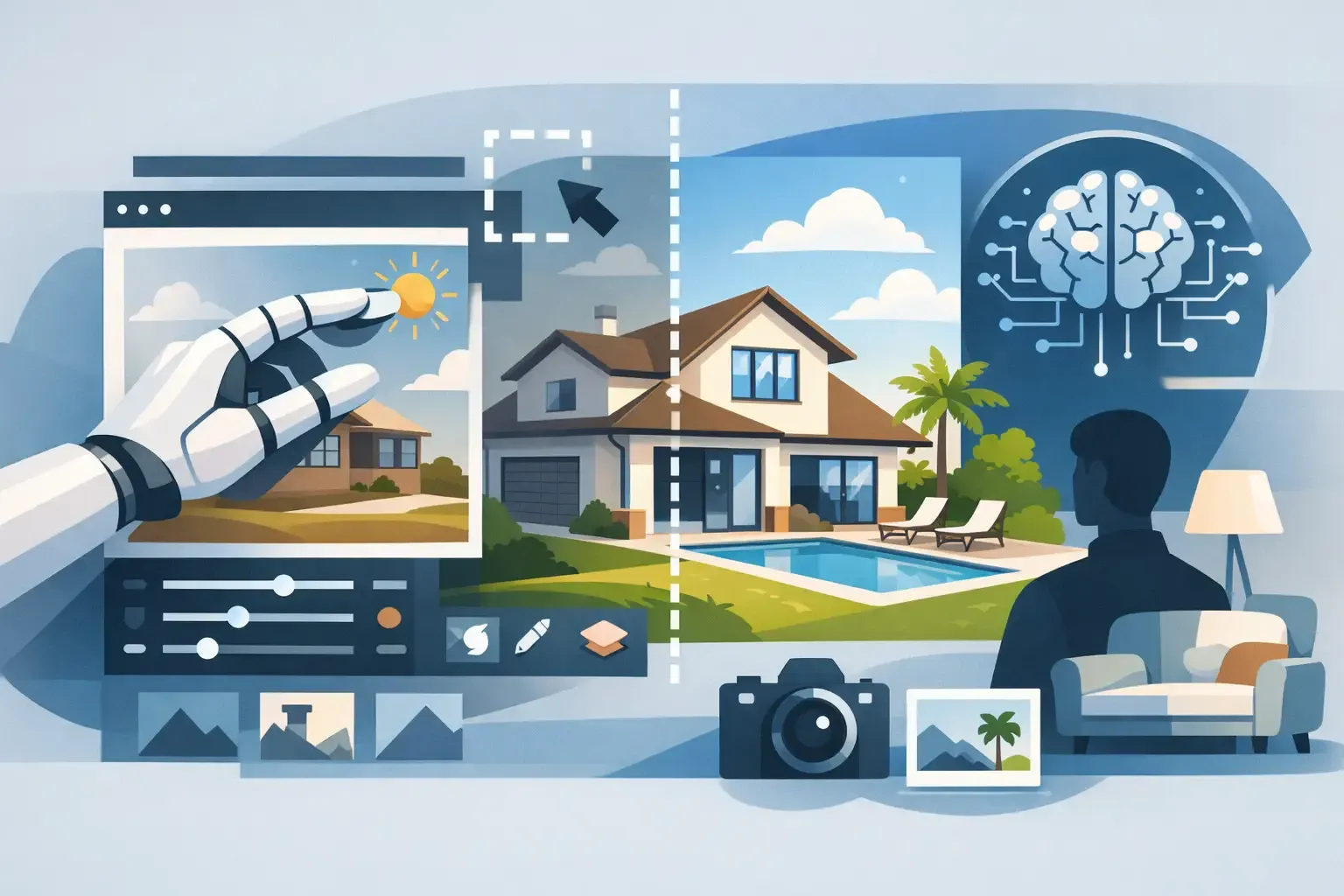
First impressions happen before buyers read a description, schedule a showing, or contact an agent. They happen in a fraction of a second while scrolling through listing portals, social feeds, property websites, and social media.
That is why AI image editing for real estate has become one of the most valuable tools in modern property marketing.
A dark kitchen, a cluttered living room, an overcast sky, or a poorly aligned smartphone photo can make an otherwise attractive property feel less desirable. Meanwhile, bright, professionally enhanced images capture attention, generate more engagement, and create a stronger perception of value.
The biggest advantage is not simply making photos look better. It is creating a faster marketing workflow that helps agents, photographers, brokerages, and marketing teams transform raw property photos into listing-ready assets, videos, social content, and advertising campaigns.
Combined with VideoEstate.ai’s real estate video creation tools, enhanced property photos can become complete marketing campaigns in minutes rather than days.
- Minutes
- From raw photos to listing-ready images
- Lower cost
- Than manual editing for every listing
- Multi-channel
- Photos, video, social, and ad assets
What is AI image editing for real estate?
AI image editing for real estate uses artificial intelligence to automatically enhance property photos and prepare them for marketing.
Instead of manually adjusting every image, AI can analyze photos and apply improvements instantly, including:
Exposure correction
Recover detail in shadows and balance brightness across an entire gallery.
Color balancing
Keep tones consistent from room to room and across exterior shots.
Perspective correction
Straighten walls and fix wide-angle distortion for a cleaner presentation.
Sky replacement
Swap dull skies with natural-looking blue skies on exterior photos.
Object removal
Remove bins, cords, vehicles, and other temporary distractions quickly.
Virtual decluttering
Create cleaner, more neutral images in occupied homes without full staging.
The goal is not to make properties look unrealistic.
The goal is to present the property as clearly and professionally as possible while maintaining accuracy and buyer trust.
For real estate professionals, this means less time spent editing and more time spent marketing listings, generating leads, and winning clients. Learn more about AI image enhancement for real estate built into listing marketing workflows.
Why property photos matter more than ever
Today’s buyers often decide whether to explore a property further based almost entirely on visual content.
Most buyers:
- Browse listings on mobile devices
- Compare multiple homes within minutes
- Form opinions before reading descriptions
- Expect professional-quality marketing
- Watch property videos before scheduling tours
When listing photos appear dark, cluttered, or inconsistent, buyers frequently move on before discovering the property’s actual strengths.
Professional image enhancement helps ensure every room, feature, and exterior shot presents the property at its best.
This is especially important when those images will later be used to create listing videos, Instagram Reels, YouTube Shorts, Facebook ads, and seller presentations.
Benefits of AI image editing for real estate professionals
Faster listing launches
Enhance entire photo galleries quickly instead of waiting days for manual revisions, especially valuable in competitive markets.
Lower marketing costs
Reduce production costs while maintaining consistent quality across independent agents, brokerages, and agencies.
Consistent branding
Maintain similar brightness levels, color profiles, and presentation standards across photographers and listings.
Better content repurposing
Turn one property shoot into videos, social posts, ads, email campaigns, and seller presentations.
When images are professionally enhanced, they become stronger source material for every marketing channel. One property shoot can easily generate weeks of content—and those same photos can feed directly into property photo-to-video workflows.
Real estate AI image editing examples
The easiest way to understand the value of AI image editing is to look at real-world situations agents face every day.
Transforming a dark interior
A photographer captures a living room during a cloudy afternoon. The room appears small and uninviting because shadows dominate the image.
AI can automatically brighten the scene, recover detail in darker areas, and balance natural light coming through the windows. The result is a space that feels larger, warmer, and more appealing to potential buyers.
Replacing an overcast sky
An exterior photo may perfectly showcase a property, but a gray sky can make the entire image feel lifeless.
AI sky replacement tools can substitute cloudy skies with natural-looking blue skies and soft clouds. This simple enhancement often creates a stronger first impression and improves curb appeal.
Removing temporary clutter
Many listings contain distractions that are not part of the property itself: trash bins, garden hoses, extension cords, cleaning supplies, parked vehicles, and moving boxes.
AI can remove these elements quickly, allowing buyers to focus on the home rather than the clutter.
Virtually decluttering occupied homes
Occupied homes frequently contain personal belongings that distract buyers. Children’s toys, excessive furniture, personal photos, and everyday household items can make spaces feel crowded.
AI virtual decluttering helps create cleaner, more neutral images without requiring sellers to completely empty the property.
Improving vacant property photos
Empty rooms are difficult for many buyers to visualize. AI-enhanced images provide a stronger foundation for virtual staging and video marketing, allowing agents to showcase realistic furniture layouts that help buyers understand how spaces can be used.
Enhancing luxury property photography
Luxury homes often feature large windows, premium finishes, and architectural details that are difficult to capture correctly.
AI can balance bright outdoor views with interior lighting, ensuring buyers can appreciate both the room and the scenery outside. This is particularly useful for penthouses, waterfront homes, mountain properties, and luxury estates.
Improving smartphone listing photos
Not every property receives a professional photo shoot. Rental properties, off-market opportunities, and urgent listings are often photographed using smartphones.
AI can dramatically improve these images through exposure correction, color enhancement, noise reduction, sharpening, and perspective correction.
Correcting wide-angle distortion
Wide-angle lenses help capture more of a room but often create distorted walls and unnatural perspectives. AI perspective correction can straighten lines and produce a cleaner, more realistic representation of the space.
Showcasing outdoor amenities
Pools, patios, terraces, gardens, outdoor kitchens, and entertainment spaces are major selling points. AI enhancement can improve clarity, vibrancy, and lighting to ensure these features receive the attention they deserve.
Enhancing twilight photography
Twilight photography is popular because it creates a premium and luxurious feel. AI can enhance sunset colors, balance interior lighting, and highlight architectural features. Many luxury listings use twilight images as their primary marketing photo.
Preparing images for property videos
Many real estate professionals use AI image enhancement before creating listing videos. Better source images produce better video results.
Enhanced photos can be transformed into property videos, Instagram Reels, YouTube Shorts, Facebook ads, and seller marketing presentations. This dramatically increases the value of every photo shoot.
Most valuable AI editing features for real estate
Lighting and exposure correction
Poor lighting remains one of the most common issues in property photography. AI can automatically brighten interiors, recover shadow details, and balance exposure throughout an entire gallery.
Perspective correction
Crooked walls and tilted vertical lines make properties look amateur. AI tools can automatically straighten architectural lines and improve overall composition.
Sky replacement
A dull sky can make an otherwise beautiful property appear less attractive. Natural-looking sky enhancement remains one of the highest-impact improvements available for exterior photos.
Object removal
AI can remove garbage bins, electrical cords, vehicles, temporary signage, reflections, and small clutter so attention stays on the property itself.
Enhanced images also serve as better foundations for virtual staging and marketing visuals. Staged rooms often generate stronger engagement because buyers can more easily imagine living in the property.
AI image editing vs traditional photo editing
Traditional editing still has a place, particularly for luxury properties and architectural photography. However, most real estate professionals prioritize speed and consistency.
| Aspect | AI editing | Traditional editing |
|---|---|---|
| Turnaround | Fast | Slower |
| Cost | Lower | Higher |
| Scalability | Scales across many listings | Difficult to scale |
| Consistency | Consistent output | Depends on editor |
| Skills required | Minimal expertise | Professional skills required |
For the majority of residential listings, AI editing delivers more than enough quality while significantly reducing production time.
Where AI has limitations
AI is powerful, but it is not magic.
No software can completely rescue photos that are extremely blurry, very low resolution, poorly composed, missing key rooms, or severely underexposed.
Ethics also matter. Real estate professionals should enhance presentation without altering permanent features or creating unrealistic expectations.
Improve presentation, not reality
Why AI image editing is part of a larger marketing system
The most successful agents do not view photo editing as the final step. They view it as the foundation of a complete marketing workflow.
Once images are enhanced, they can become property videos, Instagram Reels, YouTube Shorts, Facebook advertisements, email campaigns, seller presentations, and website content.
Instead of using photos once, agents can reuse the same visual assets across multiple channels. This generates significantly more value from every listing.
How to choose the best AI image editing tool for real estate
When evaluating software, look beyond editing features alone. The best solutions should help you:
Save time
The platform should reduce work rather than create additional steps.
Support real estate workflows
Choose tools built around listing marketing needs, not generic photo editors.
Create additional marketing assets
Let images flow directly into property videos, social content, and branded campaigns.
Scale easily
Whether you manage one listing per month or hundreds, quality should stay consistent.
Why VideoEstate.ai complements AI image editing
Photo enhancement is only the first step in modern real estate marketing. Once images are optimized, agents need a way to turn those visuals into engaging content that attracts buyers and impresses sellers.
VideoEstate.ai allows real estate professionals to transform listing photos into professional property videos automatically. Instead of spending hours editing videos manually, agents can generate branded marketing videos from existing listing assets and publish them across multiple channels.
A single set of listing photos can become:
- A property video
- Social media content
- Short-form video ads
- Seller presentations
- Marketing campaigns
All from the same source images. Explore AI real estate video generation, browse property video examples, or compare real estate video pricing plans when you’re ready to extend enhanced photos into full campaigns. For teams already using a real estate video editor online, image enhancement and video creation can live in one workflow.
Conclusion
AI image editing for real estate is no longer a luxury reserved for large brokerages. It has become a practical tool for agents, photographers, and marketing teams that want faster workflows, better presentation, and more content from every listing.
Enhanced photos create stronger first impressions, improve marketing consistency, and provide better source material for videos, social media, and advertising campaigns.
The biggest advantage is not simply better-looking images. It is the ability to move from raw property photos to complete marketing assets faster than ever before.
For real estate professionals looking to scale content production without increasing complexity, AI-powered image editing is quickly becoming an essential part of the modern marketing stack.
Frequently asked questions
What is AI image editing for real estate?
AI image editing for real estate uses artificial intelligence to automatically improve property photos through enhancements such as lighting correction, perspective adjustment, object removal, sky replacement, and image sharpening.
Can AI improve smartphone property photos?
Yes. AI can significantly improve smartphone real estate photos by correcting brightness, enhancing colors, reducing noise, and improving overall image quality.
Is AI image editing ethical in real estate?
Yes, when used to enhance presentation rather than misrepresent a property. Lighting correction, decluttering, and sky enhancement are generally accepted, while altering permanent features should be avoided.
Does AI image editing help sell houses faster?
Better property photos often generate more listing views, stronger engagement, and increased buyer interest. While photos alone do not sell homes, they play a major role in attracting potential buyers.
Can AI-edited photos be used for video marketing?
Absolutely. Enhanced images are ideal for creating property videos, social media content, and promotional campaigns. Many agents use VideoEstate.ai to convert listing photos into professional real estate videos automatically.
What is the difference between AI image editing and virtual staging?
AI image editing improves existing photos through enhancements such as lighting correction, decluttering, and perspective correction. Virtual staging adds furniture and décor digitally to help buyers visualize empty spaces.